
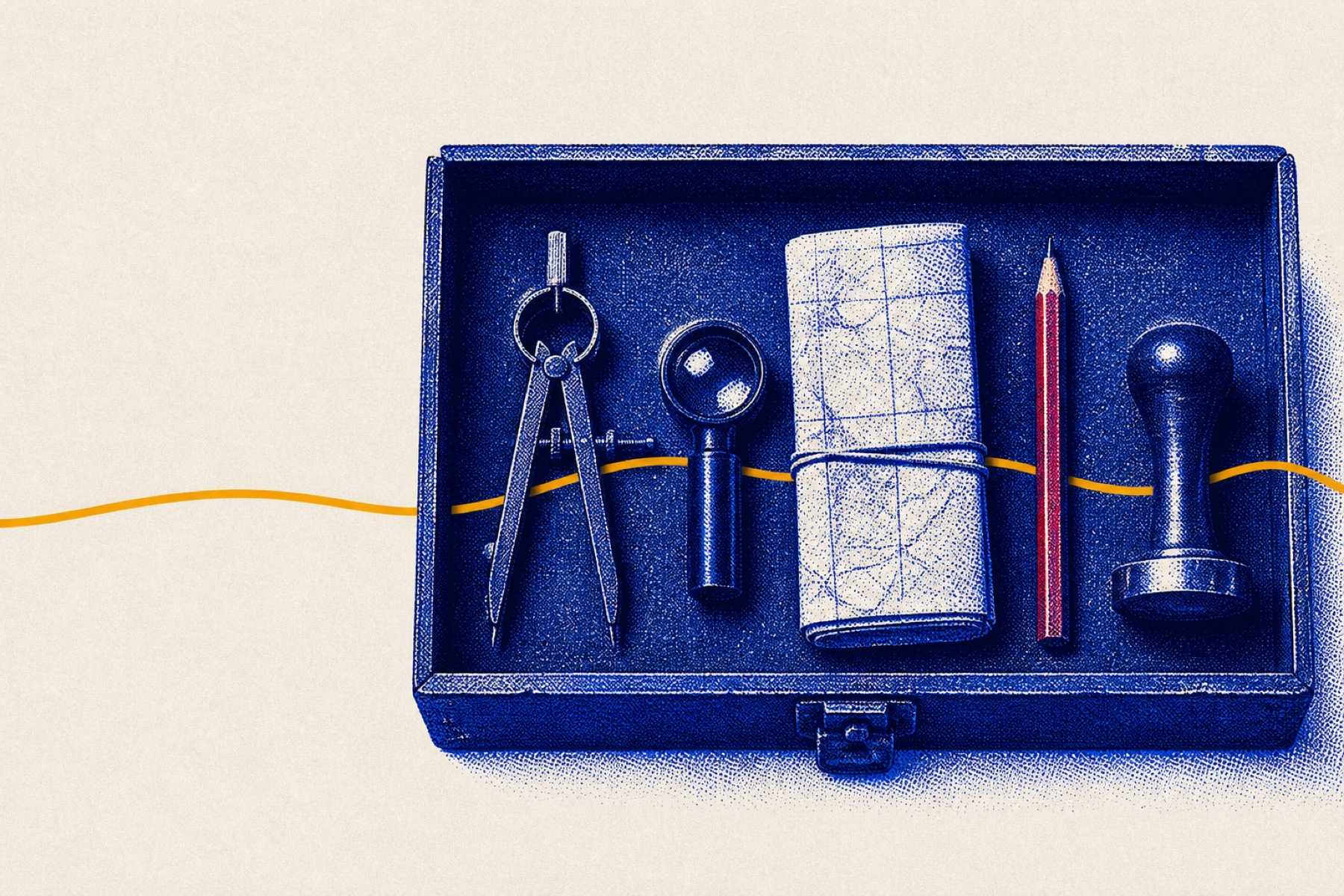
The symptom
You can feel the drop before you can explain it.
You leave the strongest model and return to the everyday one. The prose still arrives. The confidence still arrives. What disappears is harder to name: the answer becomes more agreeable, the reasoning gets flatter, and subtle mistakes survive because they look finished.
The common response is to hunt for a smarter model or a better prompt. Both can help. Neither reaches the deepest layer of the problem.
That is the working thesis behind Tradecraft. Most people optimize the first gap. Tradecraft attacks the other two. It asks whether the prompt is doing enough, then asks the more important question: did we frame the work correctly in the first place?
The honest ceiling matters.
Tradecraft cannot give a model capability it does not have. A disciplined everyday model still cannot do everything a frontier model can do on genuinely hard work. Any claim otherwise would turn the method into the kind of costume it was built to reject.
What it can do is push a model, an agent, or an operator toward the top of its available range. It removes avoidable failures caused by sloppiness: unverified facts, unexamined frames, uniform diligence, false certainty, decorative self-critique, mission drift, and work declared complete before anyone has proved it works.
The disposition underneath the procedures.
Every procedure in Tradecraft is that commitment made concrete. Edge detection applies it to your own limits. Claim calibration applies it to certainty. The self-attack applies it to your conclusion. The kill applies it to work you have become attached to. Demonstrated completion applies it to the difference between making a file and changing a real state.
This matters because every good procedure has a theater version. A risk paragraph can sound careful without naming a real risk. A review can praise, reorganize, and call itself adversarial without drawing blood. A confidence label can be added after the conclusion is already protected. Tradecraft is not the ritual. It is the willingness to let the ritual change the work.
Four parts. One standard.
PART I
Knowing
Know what you know, what you do not, and when the available evidence no longer earns the confidence.
PART II
Reasoning
Find the request behind the request, protect the crux, and attack the conclusion before handing it over.
PART III
Making
Conceive the job, set constraints, make plural options, select coldly, refine a named failure, and kill spent directions.
PART IV
Operating
Define the finish line and authority boundary, keep state current, and demonstrate completion in the medium that matters.
A method that expects to be challenged.
Tradecraft is a living operating manual. A stronger model does not replace the earlier work by authority. It attacks the frame, finds specific defects, and proposes amendments. Those amendments survive only if the reasoning survives. The changes are recorded. The disposition stays intact.
The point is not to build a doctrine that cannot be questioned. The point is to build a method that gets better because questioning it is part of the method.
Use the smallest control that changes the work.
The complete manual is for consequential work. Most tasks do not need the complete manual. The deployable control library exists for the moment one failure becomes visible: protect the crux, draw blood, lock the phase, check the seams, or stop at done.
Stacking every instruction on every task recreates the bloat the controls were designed to prevent. Good operating discipline includes knowing when the discipline adds nothing.
The artifact
The complete skill
The canonical manual, runtime kernel, audit protocol, and snippet library.
OPEN TRADECRAFT →The quick move
The controls
Twenty-eight copy-ready interventions for specific failure points.
OPEN THE DRAWER →The companion
Agentcraft
The workbench for turning repeated delegation into inspectable agents and crews.
MEET AGENTCRAFT →The rest is reps.